Mapping Digital Randomness: Contrasting Bingo Variant Algorithms with Poker Shuffle Protocols in Licensed Platforms

Digital platforms licensed for gaming rely on precise algorithms to generate outcomes that meet regulatory standards for fairness, and observers note how bingo variant systems differ markedly from poker shuffle mechanisms in both structure and implementation. Bingo draws typically employ pseudorandom number generators that select numbers sequentially from a fixed pool without repetition, whereas poker protocols focus on producing a uniformly shuffled deck through permutation techniques that rearrange all 52 cards before distribution. These distinctions arise because bingo variants such as 75-ball or 90-ball formats require progressive elimination from a grid-based set, while poker demands complete randomization across combinatorial possibilities to simulate physical card handling.
Core Algorithm Structures in Licensed Environments
Researchers have documented that bingo systems often utilize linear congruential generators or Mersenne Twister variants adapted for constrained ranges, which allows platforms to produce draws that comply with jurisdiction-specific testing protocols. In contrast, poker shuffle protocols integrate cryptographically secure pseudorandom number generators combined with algorithms like the modern Fisher-Yates shuffle to ensure every permutation occurs with equal probability. Data from industry reports indicate that licensed operators must subject both types of systems to third-party audits that verify statistical independence and unpredictability before deployment.
One study revealed that bingo implementations prioritize speed in sequential selection because each draw reduces the remaining pool, creating a chain of dependent events tracked through state management. Poker environments, however, reset the full deck state after every hand, necessitating algorithms that handle exhaustive permutations without bias accumulation over multiple rounds. Those who manage platform compliance emphasize that both approaches incorporate entropy sources from hardware or external feeds to seed the generators, yet the validation metrics diverge based on game mechanics.
Regulatory Testing and Compliance Variations
According to figures from the Nevada Gaming Control Board, operators must demonstrate that random processes withstand millions of simulated cycles without detectable patterns, a requirement applied equally to bingo and poker but measured through distinct statistical suites. Canadian provincial regulators, including the Alcohol and Gaming Commission of Ontario, have issued guidelines that require separate certification paths for number-draw systems versus deck-shuffling routines, reflecting differences in outcome distribution. Platforms operating across multiple regions therefore maintain dual testing pipelines to satisfy these varied mandates.
Implementation in Multi-Jurisdictional Platforms
What's interesting is how June 2026 regulatory updates across several North American and European markets have prompted operators to publish enhanced transparency reports detailing algorithm versions and audit frequencies. Bingo variants integrate additional checksum mechanisms to prevent sequence prediction during live sessions, whereas poker protocols embed continuous monitoring for shuffle integrity that flags any deviation from expected uniformity. Observers note that these layered controls help maintain player trust while allowing real-time adjustments when new variants emerge.
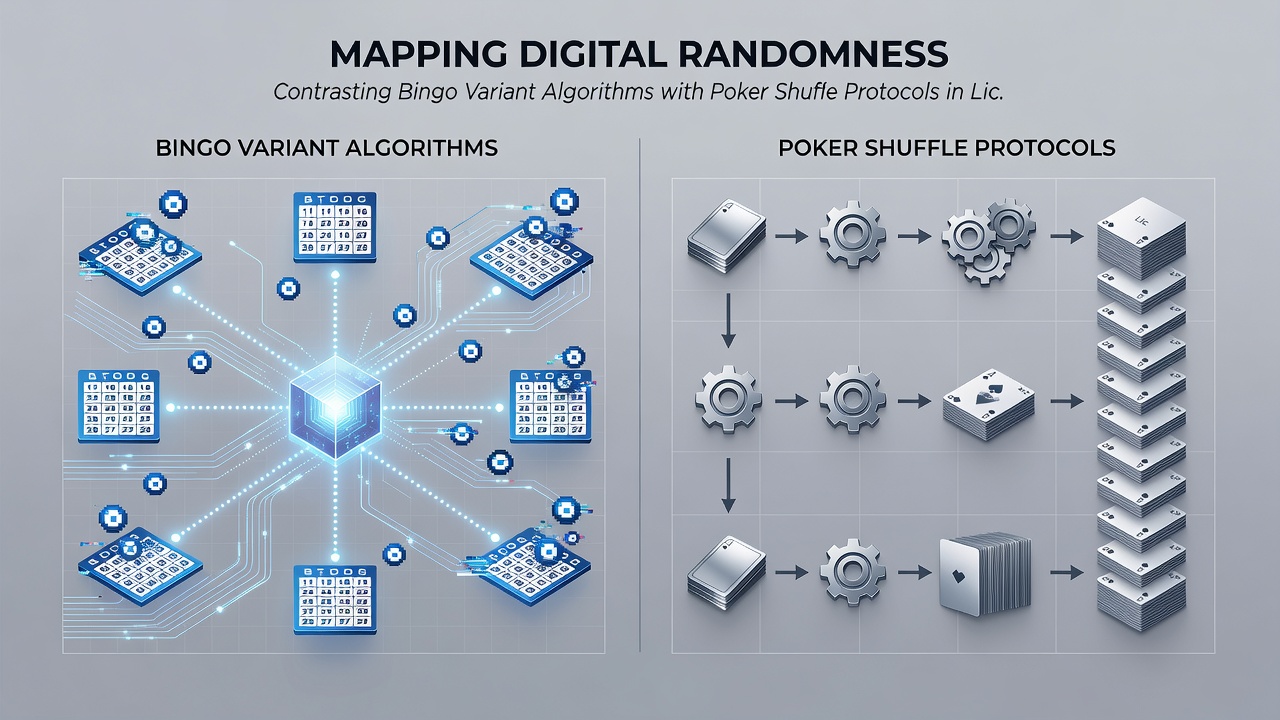
Take one case where developers adapted an existing bingo engine for a new 80-ball format by modifying the exclusion logic within the generator loop, an adjustment that required fresh certification from independent labs. Poker teams, on the other hand, often rely on established libraries that support verifiable shuffle outputs, allowing quicker integration when introducing tournament formats or multi-table configurations. Both processes converge on the shared goal of producing outcomes that resist external manipulation attempts.
Security and Entropy Management Practices
Evidence suggests licensed platforms source entropy from multiple channels including atmospheric noise, hardware timers, and dedicated random modules to strengthen the foundation of each algorithm. Bingo systems apply these seeds to bounded selection functions that track depleted numbers through bit arrays or similar structures, while poker implementations feed the same entropy into permutation generators that operate on larger state spaces. The ball's in their court when it comes to demonstrating resilience against side-channel attacks, a task that demands ongoing cryptographic reviews.
Turns out the differences extend to performance considerations as well, with bingo draws executing in milliseconds to support fast-paced gameplay and poker shuffles optimized for handling simultaneous tables without introducing latency. Academic papers on gaming mathematics highlight how these optimizations preserve randomness properties even under high transaction volumes. Platforms document these engineering choices in technical filings submitted to oversight bodies.
Conclusion
Mapping digital randomness across these domains shows that bingo variant algorithms emphasize sequential exclusion within limited sets, while poker shuffle protocols prioritize exhaustive permutation of fixed decks, yet both operate under stringent licensing frameworks that demand verifiable fairness. Regulatory bodies in diverse regions continue to refine standards as technology evolves, ensuring that platforms maintain the integrity required for sustained operation. Data from ongoing audits and technical evaluations provide the factual basis for comparing these systems without speculation about future trajectories.